
Confidently Calculate Your Hazmat Placards in Seconds
Eliminate the guesswork and stress of DOT placarding regulations. Our free Placard Helper tool gives drivers a quick and easy way to determine exactly which placards are required for their load, helping you stay compliant, safe, and on the road.
The Challenge: Complex Rules, Serious Consequences
Every professional driver knows that placarding rules for hazardous materials can be incredibly complex. Juggling different hazard classes, aggregate weight thresholds like the 1,001-pound rule, and mixed loads can lead to uncertainty and anxiety before every trip and at every inspection point.
A simple mistake can lead to:
Costly Fines: Violations can result in thousands of dollars in penalties.
Inspection Delays: Incorrect placards are a red flag for inspectors, leading to lost time.
Safety Risks: Proper placarding is essential for communicating hazards to first responders and the public.
Career Impact: Repeated compliance issues can put your CSA score and career at risk.
Our Solution: The Placard Helper
We built the Placard Helper tool to cut through the confusion. It's a straightforward calculator based on the DOT's 49 CFR Part 172 regulations, designed for the real-world needs of drivers.
With this tool, you can:
Get Instant Answers: Simply enter the weights of the materials in your load to see your exact placarding requirements.
Handle Mixed Loads with Ease: The calculator automatically handles the aggregate rules for multiple Table 2 materials.
Reduce Your Risk: Drive with the confidence that you are displaying the correct placards for your shipment.
Save Time and Effort: Stop spending time digging through the rulebook for a simple answer.

How It Works
Our tool is designed to be as simple as possible.
Enter Your Load: Input the total weight for each hazardous material class you are hauling.
Calculate Instantly: The tool processes the information based on federal regulations.
View Your Required Placards: See a clear summary of which placards, if any, you need to display on your trailer.
Ready to get started? Stop guessing and know for sure.
Disclaimer: This tool is intended for informational and guidance purposes only and is not a substitute for proper training or knowledge of the Department of Transportation's 49 CFR Hazardous Materials Regulations. The driver and carrier are ultimately responsible for ensuring full compliance with all local, state, and federal regulations. Always refer to the official regulatory text when making final placarding decisions.The Ultimate Winter Driving Guide: Tips for Truckers to Beat the Black Ice and Cold
Winter conditions present the trucking industry with its most predictable, yet unforgiving, operational challenge. For the professional driver, winter safety goes beyond merely scraping a windshield; it requires mechanical foresight, disciplined driving habits, and constant communication. This guide synthesizes essential tips for navigating freezing temperatures, avoiding the dreaded black ice, and ensuring compliance on the road.
1. Mastering Black Ice: Detection, Avoidance, and Recovery

Black Ice on Winter Road
Car driving over a bridge on a cold winter morning with black ice and frost patterns covering the road surface.
A truck does not need deep snow or a frozen highway to lose control; often, all it takes is pavement that looks wet. Black ice is thin, invisible, and removes traction instantly on an 80,000 lb vehicle, making it responsible for thousands of winter crashes every year.
Detection and Avoidance
A skilled professional reads the road like an instrument panel.
Read the Road: If the road looks wet but you see no tire spray from vehicles ahead, you are likely rolling on ice. Treat any surface that appears glossy, shiny, or “oily” as frozen.
Target Critical Zones: Be extremely cautious on bridges, overpasses, and shaded road sections, as these areas freeze first and stay frozen longer than the main highway.
Drop Speed and Increase Distance: If you suspect ice, drop speed way below normal limits. Due to the immense mass of a truck, 80,000 lbs of momentum becomes unstoppable on black ice, making stopping distance meaningless. Add extreme following distance (10+ seconds).
Drive Smoothly: Use no sudden steering, braking, or throttle changes. Friction is already gone—do not help it disappear completely.
Turn Off Cruise and Engine Brakes: Never use cruise control where ice is even a possibility, and never touch the engine brake on slick pavement.
Handling a Skid
The moment a truck begins to slide is critical:
Immediately take your foot off the accelerator.
Do not brake. Locked brakes turn a tractor-trailer into a sled.
Keep the wheels pointed where you want the truck to go, using small steering corrections.
If the trailer starts to overtake the tractor (jackknife), keep your feet off all pedals and steer gently into the skid.
If you successfully recover the vehicle, stop driving as soon as it is safe to do so, check your equipment, and take 5–10 minutes to calm down, as adrenaline can lead to a second accident. Remember: Slow is professional. Smooth is professional.
2. Cold Weather Vehicle Prep: Keeping the Mechanics Safe
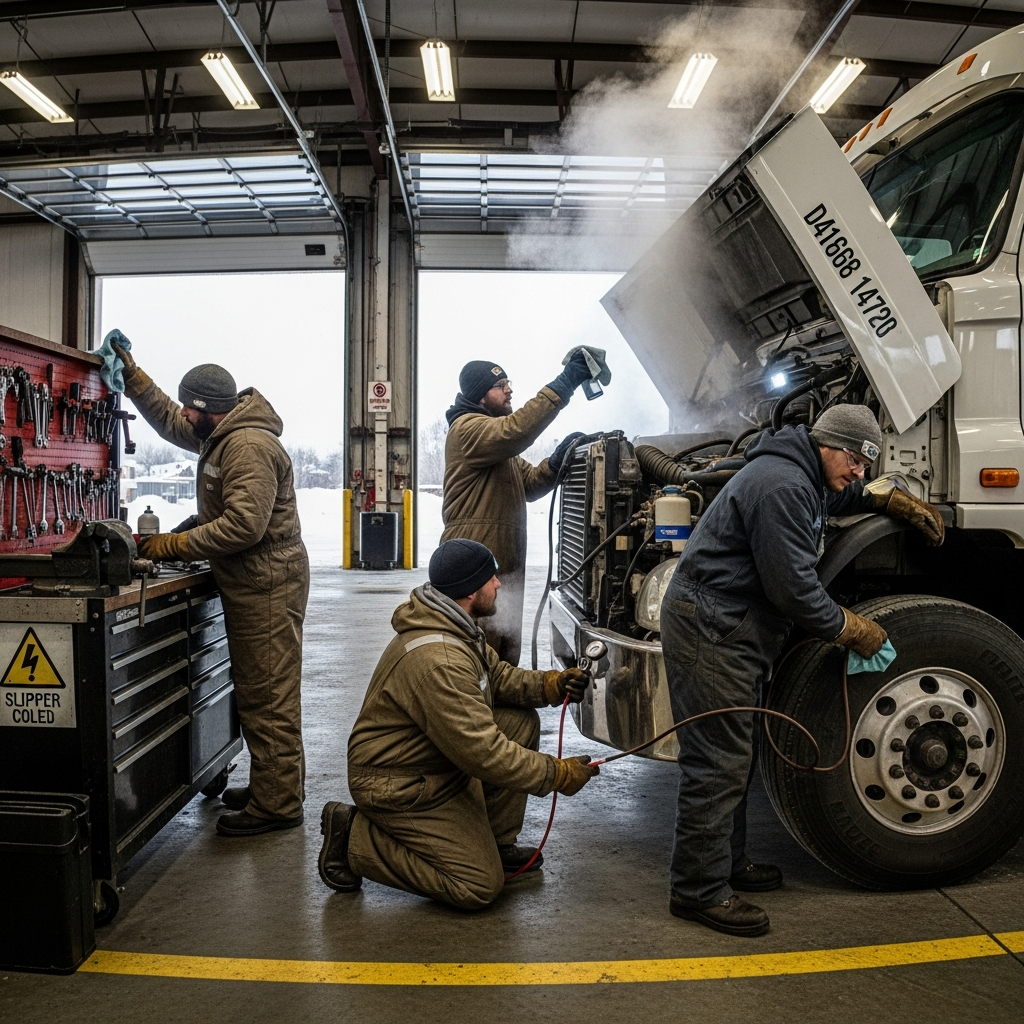
Hot engine, cold bay.
A behind-the-scenes look at the grit and precision that keeps a fleet on the road.
A regular pre-trip inspection is not sufficient in freezing weather; winter demands a heightened checklist.
Air System Maintenance
Compressed air always contains moisture which condenses into liquid as it cools in the line between the compressor and the air dryer. If it gets cold enough, this liquid freezes, threatening the air supply to vital systems, including brakes and suspensions.
Drain Tanks: You must drain the air tanks frequently to remove accumulated moisture. Pulling the drain cord on the wet tank for a few seconds can indicate the overall health of the air system.
Air Line Antifreeze: While debated (as it may damage the air dryer cartridge), some drivers suggest adding air line antifreeze directly into the primary air tank plug for the best result.
Fuel and Fluids
Cold temperatures can cause diesel fuel to gel (typically at or below 10ºF / -12ºC), requiring specific precautions.
Use Winterized Fuel and Additives: Use #1 diesel fuel or a winter blended fuel and approved fuel additives, which are important year-round but especially vital in winter to boost lubricity and manage moisture.
Prevent Condensation: Fill fuel tanks at the end of each working day to prevent condensation from forming in the tank.
Drain Filters Daily: Drain the fuel water separator and fuel filter (if applicable) after each day of use to ensure no water is left to freeze overnight.
Coolant and Oil: Use a pre-mixed 50-50 engine coolant/antifreeze mixture (suitable for temperatures down to approximately -37°F/-38°C). Never top off the cooling system with plain water, as freezing water can cause cracked engine blocks, radiators, and coolers. Use synthetic oil (such as 5w40) to greatly improve cold cranking, as it thickens less than conventional oil in extreme cold.
DEF: Diesel Exhaust Fluid (DEF) is 67.5% water and naturally freezes. Do not be concerned about freezing in the engine-mounted tank, as these tanks have built-in heaters to thaw the fluid once the engine starts.
Pre-heating and Engine Operation
Use Block Heaters: Block heaters should be used from Fall to Spring to improve engine starting and fuel economy. If an engine heater is installed, program it to start its maximum run time of two hours before departure.
Avoid Excessive Idling: Engine manufacturers generally recommend not warming up modern diesel engines by idling. Idling wastes fuel, causes unnecessary wear, and can damage downstream exhaust components; instead, start the vehicle and drive slowly to operating temperature.
Tire Safety: During the pre-trip, ensure tires are properly inflated (required air pressure is 100 PSI). Minimum tread depth is 6/32 for steer axles and 4/32 for other positions.
3. Operational Compliance and Emergency Preparedness
Winter weather can severely impact schedules, making driver compliance with Hours of Service (HOS) rules and prompt communication critical.
HOS and Delay Management
HOS Rules: Drivers are bound by regulations like the 11-Hour Driving Limit and the 14-Hour Work Window. Fatigue plays a role in 13% of all commercial vehicle crashes, making compliance critical.
Adverse Driving Exception: If severe weather (e.g., snow, fog) or road conditions were unforeseen when starting the run, you may use the adverse driving exception to gain an additional 2 hours of driving time to complete the route, provided you do not violate the 14-consecutive-hour rule.
Communication is Mandatory: If a delay caused by weather or traffic will affect pick up or delivery schedules, drivers are required to contact their immediate supervisor or dispatcher immediately. Never wait more than 15 minutes for a pickup or delivery without notifying the Terminal Manager or Dispatcher.
Required Documentation: All drivers are required to have the Federal Carrier Safety Regulations Handbook, the Handling Of Hazardous Material Pocket Book, and the Emergency Response Guide Book in their possession.
Tire Chains and Vehicle Security
Know the Law: Drivers must familiarize themselves with state-specific tire chain laws, which dictate when chains must be carried or used, particularly in high-elevation or snowy corridors. Failure to comply can result in fines, such as fines up to $1,000 in Colorado if a violation results in a highway closure.
Safe Chaining: Do not stop in the driving lane to install or remove chains.
Unattended Equipment: Vehicles should never be left unattended with the engine running. When leaving the tractor and trailer unattended, the keys must be removed, doors locked, the engine turned off, the parking brake set, and the transmission placed in gear or park.
Emergency Kit Essentials
A survival pack or emergency kit is essential, particularly during the cold winter months. It should include:
Warmth: Extra socks, boots, toque, waterproof gloves, and a subzero sleeping bag or extra blankets.
Visibility & Traction: Windshield de-icer and scraper, emergency flares, and sand or cat litter for traction.
Tools & Power: Jumper cables, a basic tool kit (with pliers, wrenches, and spare fuses/bulbs), a flashlight, and spare batteries.
Sustenance: Non-perishable food and several liters of bottled water.
Safety: A fully stocked first aid kit and a foldable shovel.
Personal Items: A spare pair of eyeglasses/contacts, if needed.
The overall philosophy is that predictable hazards, like winter driving conditions, can and must be managed through discipline and preparation.
Driving in winter conditions is like navigating a ship through a dark, cold sea—you must trust your instruments (your pre-trip), adhere strictly to the charts (HOS regulations), and always respect the power of the invisible current (black ice). Only through vigilance and preparation can you guarantee a safe harbor.
High Hooking Trailers: Don’t Make The Mistake
It all begins with an idea.
High Hooking A Trailer Is A Simple Mistake.
To be honest, high hooking a trailer is not easy to do. You really have to be distracted or the set up of the trailer has to be really off. High hooking happens when the kingpin on the trailer is higher than the fifth wheel. Since the fifth wheel pivots on a horizontal axis, the kingpin will hit the fifth wheel, slide across the top, and come to a rest in front of the fifth wheel.
Hooking a trailer to a big truck is not hard to do. I have done it 1000’s of times in the 20 years I’ve been driving a truck. Once you learn how to do it, it becomes second nature. And there-in lies the problem: COMPLACENCY! Now, high hooking trailers is not such a hard thing to do.
If you properly follow the procedure to hook up to a trailer, you can do it without incident time and time again. If you get in a hurry, get distracted, or just don’t care, you will have a problem someday. You may get away with it for a long time, but it will catch up to you.
So, what do you do?
Line up your truck with the trailer. One rule of thumb that I use is, if the drive tires in your drivers side mirror are lined up with the edge of the trailer, your fifth wheel should be lined up with the kingpin.
Back up to the trailer slowly. The fifth wheel should be at an angle facing the trailer. If the fifth wheel doesn’t pick up the trailer, STOP! All trucks are not created equal. The height of the fifth wheel to the ground is not the same for all trucks. My rule of thumb; if the tractor doesn’t “squat” and pick the trailer off the ground, GET OUT AND LOOK. Make sure the trailer is not too high. If it is, roll up the landing gear until the trailer apron touches the fifth wheel.
Continue to back under the trailer until you hear and feel the fifth wheel jaws lock onto the trailer kingpin. After you feel the hook, put the truck in low gear and “tug” on the fifth wheel. If it doesn’t come loose, then we are almost ready.
Hook up the air and electrical lines, roll up the landing gear, and do a pre-trip inspection of the trailer.
Lastly, DO NOT MOVE YOUR TRACTOR TRAILER UNTIL YOU “TUG” ON THE FIFTH WHEEL AGAIN! I have seen trailers come unhooked many times AFTER going through all the process above. You, the driver, have to be sure that your tractor-trailer is ready to hit the road.
You are the Professional driver and you will be responsible if things don’t work out on the road. High hooking can cause damage to the trailer, a refrigerated unit on the trailer, or the back of your tractor. It can be very difficult to get a trailer high enough to get the kingpin back over the top of the fifth wheel, depending on the weight in the trailer. So, do yourself a favor: Don’t High Hook A Trailer In The First Place.